
Vanuatu Citizenship by Investment: 2026 Cost and Process
Vanuatu's Development Support Program grants full citizenship for an official fee from US$130,000 plus US$5,000 due diligence. Here are the costs, who qualifies, the documents and every step to the oath.
Vanuatu citizenship by investment is a government programme that grants full citizenship, and a passport, in return for an approved contribution to the Republic of Vanuatu. Under the Development Support Program (DSP), the official citizenship fee is US$130,000 for a single applicant. A US$5,000 due diligence fee, paid to the Financial Intelligence Unit, is added (Vanuatu Citizenship Office, fees and charges). That puts the starting cost for one person at about US$135,000.
This guide covers what it costs, who qualifies, and how an application moves from the first check to the oath of allegiance, including which payments are not refunded and why the rules tightened after 2023.
Key Takeaways
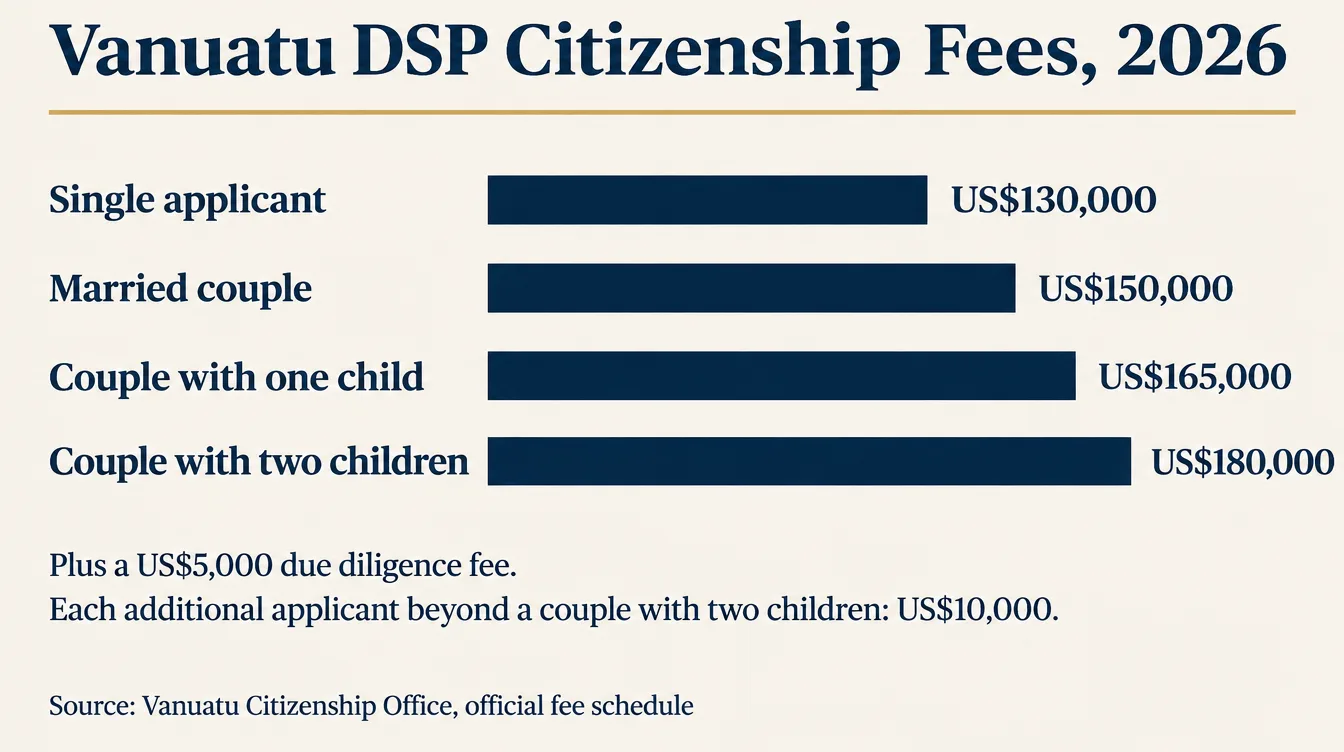
The DSP citizenship fee is US$130,000 for one person, US$150,000 for a couple and US$180,000 for a couple with two children, plus a US$5,000 due diligence fee, according to the official fee schedule.
Under the DSP regulations, 25% of the price is paid before the Citizenship Commission considers the file and is not refunded if the application is refused.
Applicants with a criminal conviction cannot be approved, and the Citizenship Amendment Act 2025 also bars anyone on an Interpol red notice.
Every file passes Financial Intelligence Unit checks, a compliance review, a Screening Committee and a Commission decision before any oath is taken.
Vanuatu recognises dual citizenship, so you can keep your current passport if your home country allows it.
What Is Vanuatu Citizenship by Investment?
It is a set of legal routes, written into Vanuatu law, that let a foreign national become a citizen by making an approved financial contribution rather than by living in the country for years. The citizenship is the same citizenship a Ni-Vanuatu holds, with a full ordinary passport.
The main route today is the Development Support Program, governed by the DSP Regulations, Order No. 33 of 2019 (Vanuatu Citizenship Office, DSP Regulations). The Citizenship Office also lists the Capital Investment Immigration Plan (CIIP), an investment-linked route whose regulations took effect in January 2023, along with smaller contribution and real estate options (Vanuatu Citizenship Office, types of citizenship).
The programme matters to Vanuatu's public finances. The International Monetary Fund's 2025 review of Vanuatu put citizenship revenue at 7.0% of GDP in 2024 and recommended an independent annual audit of the programme (IMF Country Report 25/277, RePEc listing).
DSP or CIIP: which route fits?
The DSP is a one-off contribution to the government. You pay the fee, pass due diligence, take the oath, and receive citizenship. Nothing is held back for later.
The CIIP is linked to an approved investment held in Vanuatu. New CIIP applications were paused in March 2025 while the government reviewed how CIIP funds were managed, and the pause was lifted in June 2025 according to the IMF's 2025 report. CIIP pricing depends on family size and the approved fund, so ask for a current written quote. You can compare the two routes on our DSP programme page and CIIP programme page.
How Much Does Vanuatu Citizenship Cost in 2026?
For the DSP, the official fee schedule gives these citizenship fees (Vanuatu Citizenship Office, fees and charges):
Single applicant: US$130,000
Married couple: US$150,000
Couple with one child: US$165,000
Couple with two children: US$180,000
Each additional applicant beyond a couple with two children: US$10,000
On top of the citizenship fee, the schedule lists:
Financial Intelligence Unit due diligence fee: US$5,000
Application fee: VT5,000 (Vanuatu vatu, a small administrative amount)
So a single applicant starts at about US$135,000, and a family of four at about US$185,000, before any professional fees for document translation, certification or courier costs in your home country.
What the regulations say about pricing
The 2019 DSP Regulations set these figures as the minimum selling price for each family size, with a fixed share paid into the government's account. Agents cannot sell below them, so a quote well under US$130,000 for one person does not match the regulations.
When you pay, and what is not refunded
Section 6 of the DSP Regulations splits the payment in two:
25% before the Commission considers your file. This part is not refunded if your application is refused.
75% before your citizenship certificate is issued. The certificate must be issued within 90 days of approval.
Because a quarter of the price is at risk, the right first step is a proper eligibility review before any money moves.
The government refuses Bitcoin and other crypto payments (Vanuatu Citizenship Office, information notice), and payment routes have changed during 2025 and 2026, so get the current route from your agent in writing before you transfer anything.
Who Is Eligible for Vanuatu Citizenship?
You are likely to qualify if you have a clean criminal record, can show where your funds came from, and are not barred by nationality rules. The legal tests come from the DSP Regulations and the Citizenship Amendment Act 2025.
The main applicant
No criminal convictions. The regulations state that the Commission "must not approve the application of a person who has had a criminal conviction". You supply a police clearance from your home country.
No Interpol red notice or adverse intelligence. Under the 2025 amendments, an application is set aside if the police report an Interpol listing, the Financial Intelligence Unit reports adverse information, or Immigration reports a red alert (Parliament of Vanuatu, Citizenship (Amendment) Bill 2025).
Nationality rules. The government keeps a list of restricted countries that it does not publish. Under the regulations, a citizen of a restricted country may still be accepted if they have not lived there for the last five years and can show permanent residence elsewhere.
Clean source of funds. The Financial Intelligence Unit checks where the money comes from as part of due diligence.
Family members you can include
The DSP Regulations define who counts as a dependant:
Spouse.
Children under 18, natural or adopted, of the applicant or spouse.
Children aged 18 to 25 who live with or depend on the applicant and are in full-time education.
Parents over 50 of the applicant or spouse who live with and depend on the applicant.
Each family member goes through due diligence. Children under 18 apply through a parent or guardian.
What Documents Do You Need?
Your designated agent will give you a checklist for your nationality. The core of every file is:
A certified copy of a valid passport for each applicant.
A police clearance certificate from your country of citizenship and, where relevant, countries you have lived in.
Proof of relationship for each dependant, such as birth and marriage certificates.
Proof of the source of the funds you will use.
Proof of permanent residence abroad, if you hold a passport from a restricted country.
Biometric data. Vanuatu introduced biometric passports, with biometric capture at its diplomatic missions, as part of its 2024 reforms (Vanuatu Citizenship Commission, press release, 2 December 2024).
Documents not in English or French usually need certified translation, so start early.
How the Application Process Works, Step by Step
The official process has seven stages, set out by the Citizenship Office (Vanuatu Citizenship Office, application process) and in the DSP Regulations.
Eligibility check. A designated agent reviews your background, family and funds before anything is lodged. This is where problems should be found, before the non-refundable payment.
Lodgement through a designated agent. Only licensed, designated agents can lodge applications. Under the 2025 amendments, every agent must be registered with the Vanuatu Financial Services Commission and hold a business licence.
Due diligence. The agent sends your passport, police clearance and supporting documents to the Financial Intelligence Unit, which runs its checks. Interpol and immigration checks run alongside, as described in the Commission's December 2024 statement.
Compliance review and Screening Committee. The Citizenship Office checks the file against its checklist, then the Screening Committee reviews it.
Commission decision. The Citizenship Commission approves or refuses. The decision letter follows about a week after the Commission meeting.
Oath of allegiance. The applicant takes the oath before a Commissioner of Oaths. The Citizenship Office's published process states that applicants who live abroad must travel to Vanuatu for this step. The oath and the final fee must both be completed within three months of approval, with a possible two-month extension on written request. If both deadlines pass, the approval lapses.
Certificate and passport. Once the remaining fee is paid, the citizenship certificate is printed, and you apply for your passport through the Vanuatu Department of Immigration.
Read more about each stage on our eligibility and process page.
How long does it take?
The regulations set some fixed deadlines: a Financial Intelligence Unit check within 48 hours of receiving the documents, a decision notice to the agent within 48 hours of the Commission's decision, and a certificate within 90 days of approval. They do not set one total time. In VIMB's own experience as a designated agent, approval typically takes two to three months from a complete application. Missing documents, slow police certificates and complex source-of-funds questions are what make a file take longer.
What Do You Get, and What Are the Limits?
Benefits
Vanuatu citizenship gives you a second nationality with these practical features:
No residence requirement. You do not have to move to Vanuatu or spend a set number of days there to keep your citizenship.
Dual citizenship is recognised. Vanuatu's Constitution was amended in 2013 to recognise dual citizenship, in force from 2014 (Vanuatu Citizenship Office, legislative framework). Whether your current country lets you keep its citizenship is a separate question for that country's law.
Family and future generations. Spouses and qualifying dependants can be included, and citizenship passes to your children.
No personal income tax in Vanuatu. Vanuatu has no personal income tax, capital gains tax or death duties, according to the government's investment agency (Vanuatu Foreign Investment Promotion Agency).
A Vanuatu passport. It gives visa-free entry to 85 destinations on the October 2026 Henley Passport Index, including Hong Kong, Singapore and Malaysia (Henley Passport Index, Vanuatu).
Limits
The limits deserve equal weight:
Europe, the UK and North America require visas. The Schengen Area, the UK, Ireland, the United States and Canada all require a visa for Vanuatu passport holders (Henley visa-required list). The UK rule dates from July 2023 (GOV.UK) and the EU rule became permanent in February 2025 (European Parliament).
Dual citizens cannot hold public office or take part in politics in Vanuatu, under the 2013 constitutional amendment (Vanuatu Citizenship Office, legislative framework).
Citizenship does not change where you pay tax. Tax is usually charged where you live, not by your passport. The OECD has listed citizenship and residence by investment schemes, including Vanuatu's DSP, as potentially high-risk for avoiding tax reporting, so banks will ask where you actually live (OECD, residence and citizenship by investment). Speak to a tax adviser in your home country before you plan around tax.
How Has the Programme Changed Since 2023?
The 2026 programme is stricter than it was five years ago.
Stronger screening. In 2024 the Citizenship Commission said it had tightened oversight, introduced biometric passports and required checks by the Financial Intelligence Unit, Interpol and immigration services.
New Financial Intelligence Unit procedures for DSP, CIIP and contribution programme files from January 2025 (Vanuatu Citizenship Office, FIU due diligence notice).
The Citizenship Amendment Act 2025, passed by Parliament in October 2025 with 36 votes for and none against, which made the Commission independent of political direction, barred applicants on Interpol red notices and required all agents to register (RNZ, 27 October 2025).
Revocations. The Citizenship Office states that the current Commission has revoked almost 30 citizenships granted contrary to the Citizenship Act and the Constitution (Vanuatu Citizenship Office, news).
These changes followed the UK's visa requirement of July 2023 and the EU's suspension of visa-free travel, which covered all Vanuatu passports from February 2023 and became permanent in February 2025. For a new applicant, the effect is simple: expect thorough checks and give full, honest answers.
How to Choose a Designated Agent
Your agent lodges the file, handles the money and speaks to the government on your behalf, so the choice matters. Check these points before signing:
Is the agent on the official list? The Vanuatu Citizenship Office publishes an index of designated agents. Check that your agent appears on it.
Is the agent registered under the 2025 rules? Registration with the Vanuatu Financial Services Commission is now required.
Is there an office in Port Vila? The DSP Regulations require designated agents to be Vanuatu citizens with their main office in Port Vila. Overseas sales offices usually work through such an agent.
Will you get a written fee breakdown? It should separate the citizenship fee, the due diligence fee and service fees, and say which payments are refundable.
Will they review your eligibility first? A careful agent checks your criminal record, nationality and source of funds before the first, non-refundable payment.
The regulations also tie you to one agent: you can only switch if your agent has made no progress on your file for more than six months.
Frequently Asked Questions
How much does Vanuatu citizenship cost?
Under the DSP, the official citizenship fee is US$130,000 for one person, US$150,000 for a couple and US$180,000 for a couple with two children. A US$5,000 Financial Intelligence Unit due diligence fee and a small application fee are added. A single applicant starts at about US$135,000.
Can my whole family apply together?
Yes. A spouse, children under 18, children aged 18 to 25 in full-time education who depend on you, and dependent parents over 50 who live with you can be included. Each additional applicant beyond a couple with two children adds US$10,000 under the DSP schedule.
Do I have to visit Vanuatu?
There is no requirement to live in Vanuatu. The Citizenship Office's published process says applicants who live abroad must travel to Vanuatu to take the oath of allegiance before a Commissioner of Oaths. Ask your agent how the oath is being handled at the time you apply.
Is Vanuatu citizenship by investment legal?
Yes. It is set out in Vanuatu's Citizenship Act and the DSP Regulations and run by the government's Citizenship Office and Commission.
The Bottom Line
Vanuatu citizenship by investment is a legal, government-run route to a second citizenship, with a published DSP fee schedule that starts at US$130,000 plus a US$5,000 due diligence fee for one person. It suits people who want a recognised second nationality for their family, without moving, and whose travel centres on places on the Henley visa-free list, such as Hong Kong, Singapore, Malaysia and the Pacific. It does not suit anyone whose main goal is visa-free travel to Europe or the UK. To see how that price compares with the Caribbean and other Pacific programmes, read our comparison of the cheapest citizenship by investment countries.
If it fits your plans, the next step is the free eligibility check. It takes a few minutes, carries no commitment, and comes before any payment. You can also read how VIMB supports you after approval.
About This Guide
This guide was written by the VIMB editorial team in Port Vila. VIMB (Vanuatu Investment Migration Bureau) is a government-appointed designated agent listed on the Vanuatu Citizenship Commission's official index, with an office in Port Vila since 2017. VIMB has helped clients through more than 1,000 granted citizenships. You can read more about VIMB and why clients choose VIMB.
Every fee and rule in this guide comes from a named public source, checked on 13 November 2026. Fees and rules are set by the Government of Vanuatu and can change. This guide is general information, not legal, tax or immigration advice. If you spot an error, tell us through our contact page and we will correct it and update the date at the top. You can meet the people behind VIMB on our team page, and read how we handle your data in our privacy policy.