
How to Get a Second Passport in 2026: 5 Routes Compared
Five main legal routes to a second passport in 2026: descent, marriage, naturalisation, residency and investment, compared on time, cost and eligibility.
There are five main legal routes to a second passport in 2026: citizenship by descent, by marriage, by naturalisation after years of residence, by residency through investment followed by naturalisation, and citizenship by investment. The first four depend on your family tree, your spouse or several years of living abroad. Citizenship by investment is the only route here you can start without an ancestor, a spouse or a move abroad, if you can invest from US$135,000 in Vanuatu's case.
This guide compares the five main legal routes on the three things that decide which one is open to you: how long it takes, what it costs, and who qualifies. Every legal rule below comes from a government or court source, checked on 23 November 2026. Vanuatu programme details that come from VIMB, a government-appointed designated agent, are labelled as such. VIMB is a paid designated agent for Vanuatu's citizenship by investment programme, which is route 5 in this guide.
Key Takeaways
Descent is usually the cheapest in fees, but only if you have the right ancestor. Italy limited most claims to parents and grandparents for applications made after 27 March 2025 (confirmed by law in May 2025).
In the countries covered here, marriage and naturalisation usually need years of residence: 3 years for spouses of US citizens, 5 in Germany, 3 of the last 5 in Canada.
Buying residency is not buying citizenship. Portugal now asks most applicants for 10 years of legal residence before naturalisation.
Citizenship by investment is the only route here that needs no ancestor, spouse or years of residence. In Vanuatu, typical approval is 2 to 3 months, according to VIMB.
Before any route, check that your home country allows you to keep your first passport.
What Is a Second Passport, and Is It Legal?
A second passport follows second citizenship, so citizenship is the real goal. Every route in this guide is a lawful process run by a government, and people often call the result a "plan B passport": a second nationality kept ready in case travel, business or politics at home changes.
The legal question that matters most is not about the new country but about your current one. Some countries let you hold two citizenships, and some take yours away when you acquire another. Check this first, using our guide to which countries allow dual citizenship.
The Five Routes at a Glance
Fees shown are the government fee for the final citizenship application, or the minimum investment; routes 2 to 4 also need a residence permit first, with its own fees.
Route 1, descent (Ireland)
Time: no residence needed
Final fee or investment: an administrative registration fee
Who qualifies: a qualifying parent or grandparent
Route 2, marriage (United States)
Time: 3 years as a permanent resident
Final fee or investment: US$760 N-400 fee on paper
Who qualifies: a citizen spouse, plus legal residence
Route 3, naturalisation (Canada, Germany)
Time: 3 years in Canada, 5 in Germany
Final fee or investment: C$653 in Canada, €255 in Germany
Who qualifies: legal residents, often with language tests
Route 4, residency by investment (two examples)
Time, Portugal example: 10 years for most applicants
Investment, Italy example: from €250,000
Who qualifies: investors who then complete naturalisation
Route 5, citizenship by investment (Vanuatu)
Time: no residence needed
Final fee or investment: from US$135,000
Who qualifies: adults with a clean record and lawful funds
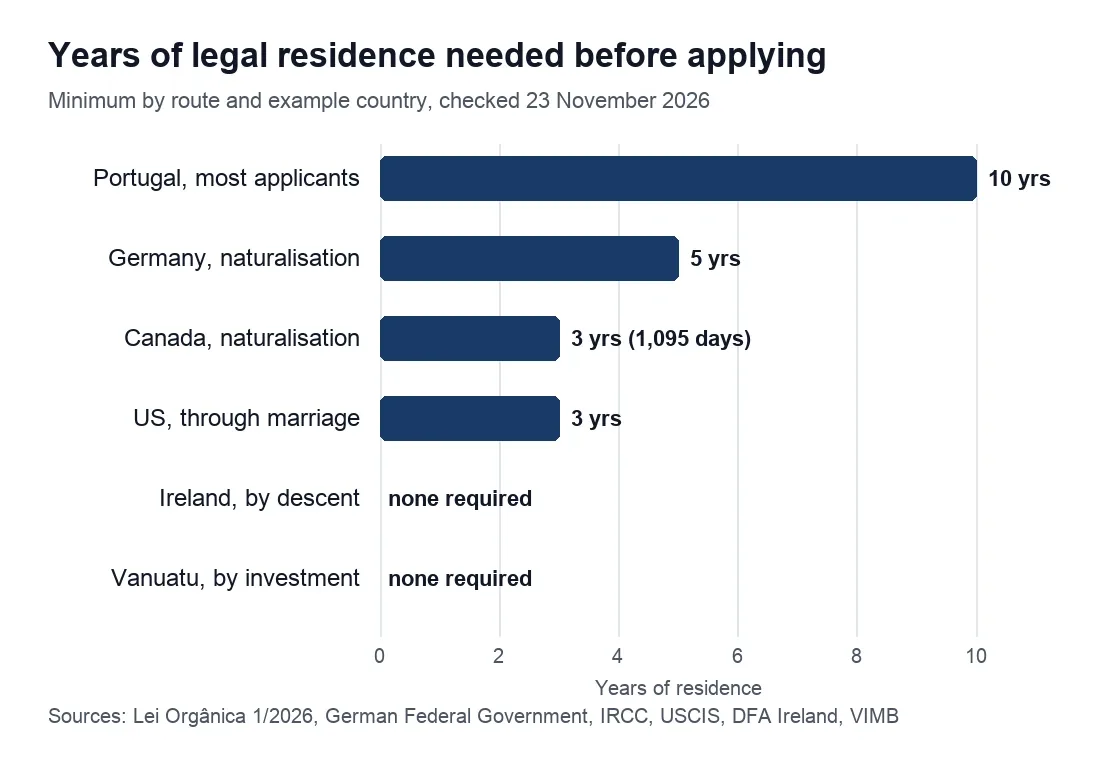
Minimum legal residence before applying, by route. Sources: Portugal, Lei Orgânica 1/2026, German Federal Government, IRCC Canada, USCIS, DFA Ireland. Vanuatu: no residency requirement, per VIMB, a government-appointed designated agent. Checked 23 November 2026.
Processing time comes on top, and most routes also ask for language or civics tests.
Route 1: Citizenship by Descent
Citizenship by descent recognises an entitlement you already hold through a parent or grandparent. You pay only administrative fees, but you need the qualifying ancestor.
Ireland: a grandparent born on the island
Ireland lets anyone with a grandparent born anywhere on the island of Ireland register as an Irish citizen through the Foreign Births Register (Department of Foreign Affairs, registering a foreign birth). Once registered, you can apply for an Irish passport, which is also an EU passport.
The cost is an administrative registration fee. As of March 2024, the Minister for Foreign Affairs said processing had fallen to about 9 months, from two and a half years in 2022 (Houses of the Oireachtas, written answer, 20 March 2024). Incomplete files take longer, and you will need your grandparent's original civil birth certificate.
Italy: the 2025 reform closed the door for most
Since March 2025, most Italian descent claims stop at a parent or grandparent. Italy used to recognise an Italian ancestor of almost any generation. Decree-Law 36/2025, which became Law No. 74 of 23 May 2025, changed that for applications made after 27 March 2025. The applicant needs a parent or grandparent who held only Italian citizenship. The alternative is an Italian-citizen parent who lived in Italy for two years before the applicant's birth (Consulate General of Italy in Hong Kong, citizenship iure sanguinis).
For people whose link runs through a great-grandparent, that ends the claim. Descent rules can tighten with little warning.
Best for: people with a qualifying parent or grandparent and the original documents to prove it.
Route 2: Citizenship by Marriage
Marriage to a citizen shortens naturalisation in many countries, but it rarely skips it. In the countries covered here, you usually still have to live there, hold residence status and pass the usual checks.
The United States is a clear example. The spouse of a US citizen can apply for naturalisation after 3 years as a lawful permanent resident. The couple must have lived in marital union for those years, with the spouse a citizen throughout (USCIS Policy Manual, Volume 12, Part G, Chapter 3). Getting the green card itself comes first, so the real timeline is longer than 3 years. The naturalisation filing fee is US$760 on paper or US$710 online (USCIS, Form N-400).
Authorities test whether a marriage is genuine; a marriage for a passport is fraud, not a route.
Best for: people already married to a citizen and willing to live in that country for several years.
Route 3: Naturalisation Through Residence
Naturalisation is the standard way adults become citizens: you move, hold legal residence for a set number of years, then apply. It costs little in fees but a great deal in time.
Residence periods vary widely. Canada asks for at least 1,095 days physically in Canada during the 5 years before you apply (Immigration, Refugees and Citizenship Canada, eligibility). Germany asks for 5 years and charges an adult €255 (German Citizenship Act, section 38). Its 2024 reform cut the period from 8 years and added a 3-year fast track, since abolished (German Federal Government, naturalisation remains tied to integration). Portugal now asks most nationalities for 10 years, covered in the next route.
Fees are low next to the time involved. Canada charges an adult C$530 to process the application plus a C$123 right of citizenship fee, C$653 in total (IRCC, right of citizenship fee notice). You also need a residence permit first, through work, study, family or investment. That is often the hardest step.
Best for: people free to relocate for 3 to 10 years who can secure a residence permit.
Route 4: Residency by Investment, Then Citizenship
Residency by investment programmes sell a residence permit, not a passport. You invest, receive the right to live in the country, then wait out the normal naturalisation period like any other resident. The cost varies by programme. Italy's investor residence route, for example, requires at least €250,000 in an innovative startup or €500,000 in an Italian company (Italian Immigration Act, Article 26-bis).
Portugal shows how long that wait can become. Lei Orgânica n.º 1/2026 came into force on 19 May 2026. It requires at least 10 years of legal residence before naturalisation for most nationalities. Nationals of Portuguese-speaking countries and EU citizens need 7 years (Lei Orgânica n.º 1/2026, Diário da República, 18 May 2026; official text, PDF). An investor who arrives in 2026 on a residence permit would wait until about 2036 to apply.
Europe has also closed the faster alternative. On 29 April 2025, the Court of Justice of the European Union ruled that Malta's investor citizenship scheme broke EU law. It found that "the acquisition of Union citizenship cannot result from a commercial transaction" (Court of Justice of the EU, press release 52/25, Commission v Malta). These are often called investor citizenship schemes. In practice, an EU passport through investment now usually means years of residence first.
Best for: people who want to live in a specific country long term and treat citizenship as a distant bonus.
Route 5: Citizenship by Investment
Citizenship by investment grants full citizenship, and a passport, in return for an approved economic contribution to the country. In Vanuatu's case, you apply from home, and the government's background checks, not years of residence, decide the outcome. Vanuatu has two government-approved options: the Development Support Program (DSP) and the Capital Investment Immigration Plan (CIIP).
Most of these programmes are in the Caribbean, plus Vanuatu in the Pacific.
In March 2024, St Kitts and Nevis, Antigua and Barbuda, Dominica and Grenada signed a memorandum of agreement. It set a minimum investment of at least US$200,000 for their programmes (SKNIS, St Kitts and Nevis Information Service, 22 March 2024).
The DSP charges US$130,000 for one applicant plus a US$5,000 due diligence fee (Vanuatu Citizenship Office, fees and charges). For a full price comparison of the programmes still open, see our guide to the cheapest citizenship by investment countries.
Price is not the only trade-off. Citizenship by investment is scrutinised by the countries you will travel to, and visa-free access can change. The EU, for example, reintroduced the visa requirement for Vanuatu nationals, so a Schengen visa is now required (Regulation (EU) 2025/11, EUR-Lex). Our list of Vanuatu passport visa-free countries shows where it still travels freely.
What every programme checks
Fast does not mean easy. Legitimate programmes run due diligence on every applicant, and Vanuatu's process passes each file through Financial Intelligence Unit checks, a screening committee and the Citizenship Commission before any oath is taken (Vanuatu Citizenship Office, application process). Expect to prove:
your identity and civil status
a clean criminal record
the lawful source of your funds
your family relationships, for each dependant
Best for: people who need a second citizenship without relocating and can show lawfully earned funds.
How to Choose the Right Route for You
Work through these questions in order. The first "yes" usually points to your best route.
Do you have a parent or grandparent who held citizenship elsewhere? Check descent first. It costs the least, and it may lead to an EU passport.
Are you married to a citizen of the country you want? Marriage shortens naturalisation, though in the countries covered here you will usually still need to live there.
Can you move abroad for 3 to 10 years? Naturalisation, with or without a residency investment, is open to you.
Do you need the second passport within months, without moving? Look at citizenship by investment, and budget for due diligence on your source of funds.
Two checks apply whatever you choose. Confirm that your home country allows dual citizenship, or you may lose your first passport. And confirm the passport you are working towards opens the places you actually travel to.
The Investment Route in Four Steps
The investment route follows the same broad shape:
Check eligibility. Confirm your age, record and source of funds meet the rules before you spend anything.
Choose a programme. Weigh price, family cost and travel access.
Appoint an agent. In Vanuatu, applications go through designated agents listed by the Citizenship Office (Vanuatu Citizenship Office, designated agents).
Pass due diligence, then take the oath. Background checks decide the outcome, and the oath follows approval (Vanuatu Citizenship Office, application process).
For Vanuatu's exact fees, documents and stages, read our Vanuatu citizenship by investment guide.
Where Vanuatu Fits
Vanuatu's DSP starts from US$135,000 including the due diligence fee, below the US$200,000 minimum that four Caribbean programmes agreed in 2024. VIMB, as a government-appointed designated agent, confirms the programme gives:
No residency requirement, and applications are processed remotely
Citizenship passes to future generations
Spouse, children and parents can be included
Two government-approved programmes: DSP and CIIP
For travel, the Henley Passport Index of 16 November 2026 lists 84 visa-free or visa-on-arrival destinations for Vanuatu passport holders (Henley Passport Index, Vanuatu list). Our analysis of where the Vanuatu passport ranks explains what that means in practice.
To qualify, you need to be 18 or older, of good character with a clean criminal record, and able to show a lawful source of funds for the investment. The full sequence is on our eligibility and process page.
Frequently Asked Questions
What is the easiest way to get a second passport?
Descent is easiest if you have a qualifying parent or grandparent: no residence and only administrative fees. Without that ancestor, citizenship by investment is the only route here without a residence or family requirement.
Can I get a second passport without living in the country?
Yes, through descent or citizenship by investment. In the countries covered here, marriage and naturalisation usually require years of residence. According to VIMB, Vanuatu's programme has no residency requirement, and applications are processed remotely.
How long does it take to get second citizenship?
It depends on the route. In the countries covered here, naturalisation takes 3 to 10 years of residence. Irish descent registration took about 9 months in 2024. Vanuatu's typical approval is 2 to 3 months, according to VIMB.
Is a plan B passport legal?
Yes. A plan B passport is simply a second citizenship obtained through a lawful government process. The legal risk lies with your home country: if it does not allow dual citizenship, acquiring a second one may cost you your first.
Can I buy an EU passport?
Not directly. In April 2025 the EU Court of Justice ruled that Malta's investor citizenship scheme broke EU law, finding that "the acquisition of Union citizenship cannot result from a commercial transaction". In practice, an EU passport through investment now usually means years of residence first: 10 years in Portugal for most nationalities.
The Bottom Line
Descent and marriage depend on who you are related to, naturalisation and residency cost years of your life, and citizenship by investment costs money. If you have the ancestor, start with descent. If you need a second citizenship without relocating and can meet the investment, citizenship by investment is the route that fits.
If that last option fits, the next step is to check whether you qualify. The eligibility check is quick and comes with no commitment, and an advisor usually replies within one business day.
About This Guide
This guide was written by the VIMB editorial team in Port Vila, Vanuatu. VIMB is a paid, government-appointed designated agent for Vanuatu's citizenship by investment programme, which is route 5 in this guide, and has worked from Port Vila since 2017. You can read more about VIMB and meet the people behind it on our team page.
Legal rules come from named government or court sources, checked on 23 November 2026, and VIMB figures are labelled. This is general information, not legal or immigration advice. To report an error, use our contact page. See our privacy policy.